Libraries And Publishers
At the 2007 International Digital Publishing Forum (IDPF) in New York May 9th, publishers and vendors discussed the future of ebooks in an age increasingly dominated by large-scale digitization projects funded by the deep pockets of Google and Microsoft.
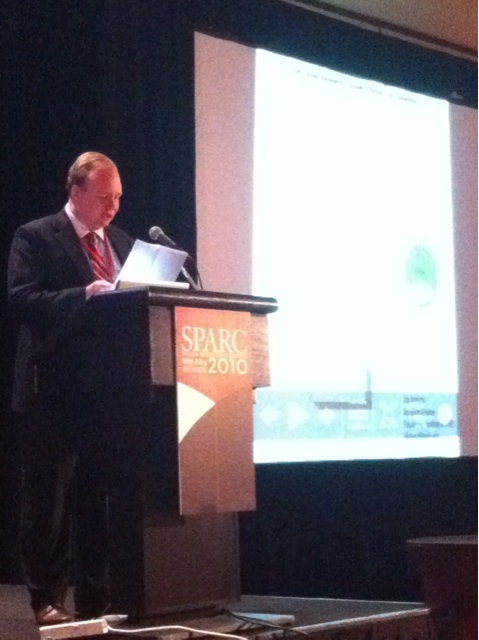
In a departure from the other panels, which discussed digital warehouses and repositories, both planned and in production from Random House and HarperCollins, Peter Brantley, executive director of the Digital Library Federation and Dale Flecker of Harvard University Library made a passionate case for libraries in an era of information as a commodity.
Brantley began by mentioning the Library Project on Flickr, and led with a slightly ominous series of slides: “Libraries buy books (For a while longer), followed by “Libraries don’t always own what’s in the book, just the book (the “thing” of the book).¨
He then reiterated the classic rights that libraries protect: The Right to Borrow, Right to Browse, Right to Privacy, and Right to Learn, and warned that “some people may become disenfranchised in the the digital world, when access to the network becomes cheaper than physical things.” Given the presentation that followed from Tom Turvey, director of the Google Book Search project, this made sense.
Brantley made two additional points, saying “Libraries must permanently hold the wealth of our many cultures to preserve fundamental Rights, and Access to books must be either free or low-cost for the world’s poor.”¨ He departed from conventional thinking on access, though, when he argued that this low-cost access didn’t need to include fiction. Traditionally, libraries began as subscription libraries for those who couldn’t afford to purchase fiction in drugstores and other commercial venues.
Finally, Brantley said that books will become communities as they are integrated, multiplied, fragmented, collaborative, and shared, and publishing itself will be reinvented. Yet his conclusion contained an air of inevitability, as he said, “Libraries and publishers can change the world, or it will be transformed anyway.”
A podcast recording of his talk is available on his site.
Google Drops A Bomb
Google presented a plan to entice publishers to buy into two upcoming models for making money from Google Book Search, including a weekly rental “that resembles a library loan” and a purchase option, “much like a bookstore,” said Tom Turvey, director of Google Book Search Partnerships.¨ The personal library would allow search across the books, expiration and rental, and copy and paste. No pricing was announced. Google has been previewing the program at events including the London Book Fair.
Turvey said Google Book Search is live in 70 countries and eight languages. Ten years ago, zero percent of consumers clicked before buying books online, and now $4 billion of books are purchased online. “We think that’s a market,”Turvey said, “and we think of ourselves as the switchboard.”
Turvey, who previously worked at bn.com and ebrary, said publishers receive the majority of the revenue share as well as free marketing tools, site-brandable search inside a book with restricted buy links, and fetch and push statistical reporting.¨He said an iTunes for Books was unlikely, since books don’t have one device, model or user experience that works across all categories. Different verticals like fiction, reference, and science, technology and medicine (STM), require a different user experience, Turvey said.
Publishers including SparkNotes requested a way to make money from enabling a full view of their content on Google Books, as did many travel publishers. Most other books are limited to 20 percent visibility, although Turvey said there is a direct correlation between the number of pages viewed and subsequent purchases.
This program raises significant privacy questions. If Google has records that can be correlated with all the other information it stores, this is the polar opposite of what librarians have espoused about intellectual freedom and the privacy of circulation records. Additionally, the quality control questions are significant and growing, voiced by historian Robert Townsend and others.
Libraries are a large market segment to publishers. It seems reasonable to voice concerns about this proposal at this stage, especially those libraries who haven’t already been bought and sold. Others at the forum were skeptical. Jim Kennedy, vice president and director at the Associated Press, said, “The Google guy’s story is always the same: Send us your content and we’ll monetize it.”
Ebooks Ejournals And Libraries
Dale Flecker of the Harvard University Library gave a historical overview of the challenges libraries have grappled with in the era of digital information.
Instead of talking about ebooks, which he said represent only two percent of usage at Harvard, Flecker described eight challenges about ejournals, which are now “core to what libraries do” and have been in existence for 15-20 years. Library consultant October Ivins challenged this statistic about ebook usage as irrelevant, saying “Harvard isn’t typical.” She said there were 20 ebook platforms demonstrated at the 2006 Charleston Conference, though discovery is still an issue.
First, licensing is a big deal. There were several early questions: Who is a user? What can they do? Who polices behavior? What about guaranteed performance and license lapses? Flecker said that in an interesting shift, there is a move away from licenses to “shared understandings,” where content is acquired via purchase orders.¨
Second, archiving is a difficult issue. Harvard began in 1630, and has especially rich 18th century print collections, so it has been aware that “libraries buy for the ages.” The sticky issues come with remote and perpetual access, and what happens when a publisher ceases publishing.
Flecker didn’t mention library projects like LOCKSS or Portico in his presentation, though they do exist to answer those needs. He did say that “DRM is a bad actor” and it’s technically challenging to archive digital content. Though there have been various initiatives from libraries, publishers, and third parties, he said “Publishers have backed out,” and there are open questions about rights, responsibilities, and who pays for what. In the question and answer period that followed, Flecker said Harvard “gives lots of money” to Portico.”
Third, aggregation is common. Most ejournal content is licensed in bundles and consortia and buying clubs are common. Aggregated platforms provide useful search options and intercontent functionality.
Fourth, statistics matter, since they show utility and value for money spent. Though the COUNTER standard is well-defined and SUSHI gives a protocol for exchange of multiple stats, everyone counts differently.
Fifth, discovery is critical. Publishers have learned that making content discoverable increases use and value. At first, metadata was perceived to be intellectual property (as it still is, apparently), but then there was a grudging acceptance and finally, enthusiastic participation. It was unclear which metadata Flecker was describing, since many publisher abstracts are still regarded as intellectual property. He said Google is now a critical part of the discovery process.
Linkage was the sixth point. Linking started with citations, when publishers and aggregators realized that many footnotes contained links to articles that were also online. Bilateral agreements came next, and finally, the Digital Object Identifier (DOI) generalized the infrastructure and helped solve the “appropriate copy” problem, along with OpenURL. With this solution came true interpublished, interplatform, persistent and actionable links which are now growing beyond citations.
Seventh, there are early glimpses of text mining in ejournals. Text is being used as fodder for computational analysis, not just individual reading. This has required somewhat different licenses geared for computation, and also needs a different level of technical support.¨Last, there are continuing requirements for scholarly citation that is: • Unambiguous •Persistent • At a meaningful level. Article level linking in journals has proven to be sufficient, but the equivalent for books (the page? chapter? paragraph?) has not been established in an era of reflowable text.
In the previous panel, Peter Brantley asked the presenters on digital warehouses about persistent URLS to books, and if ISBNs would be used to construct those URLs. There was total silence, and then LibreDigital volunteered that redirects could be enabled at publisher request.
As WorldCat.org links have also switched from ISBN to OCLC number for permanlinks, this seems like an interesting question to solve and discuss. Will the canonical URL for a book point to Amazon, Google, OCLC, or OpenLibrary?